Tuesday, February 15, 2011

Feb. 15 Touring the north country: Galilee


One of the amazing things about Israel is its small size.  Within a couple of hours you can drive from lush green fields to mountains to wasteland to sea shore.  It is difficult for the western mind to understand how quickly the terrain and climate could change in a day’s walk.  In the US we would have to drive hours and hours to be able to experience all of the different climates.  There are even snow caps atop Mount Hermon to the north.  I’m amazed at how a small understanding of geography can affect how you read and understand the Bible.
This morning, we boarded the bus and headed off to Nazareth.  The little home town of Jesus is now a metropolis of over 70,000 people.  The city now spans portions of the valley and the hills surrounding the old town.  We took a few pictures from the road, but the pictures from the Mount of the Precipice are more inclusive.  We ascended the road to the top of the mountain and then took a short hike up the path to the overlook.  What an awesome sight!  On the north we had the view of Nazareth and to the south we had the view of the lush green Jezreel valley. Jezreel means, “God will plant.”  It is evident that this valley is close to the heart of God and has been a place where He has worked throughout Bible history and will into the future.   It is no doubt that Jesus spent time up there as a boy and young man.  There is Mount Tabor where the account of Deborah and Barak took place, Mount Gilboa where we can see Gideon’s spring, Megiddo where King Ahab had a palace and where the final battle of Armageddon will culminate, and also Mount Carmel where Elijah took on the prophets of Baal.  I can imagine that Jesus spent some time there remembering His work throughout history and contemplating the final work of God in the future.
After Pastor Brian’s message about the valley we took some pictures and boarded the bus heading toward Megiddo.  We walked up the hill and viewed the 3 chambered city gates that made it nearly impenetrable.  This city was an ancient one bearing evidence of the pagan, hedonistic idolatry of the Canaanite cultures that occupied it for years before the land was possessed by the children of Israel.  From the hill, we could view the Jezreel Valley and see Nazareth and Mount Tabor just behind it.  We had the opportunity to see the water system built by King Ahab so that the city would always have a water source even under siege.  Ahab was a smart and industrious man, but he sure knew how to be a crybaby!
Our next trip took us to Mount Carmel, there we again looked into the Jezreel Valley and had a challenge from II Samuel where Elijah faced the prophets of Baal.  You could almost hear the thousands of people shouting, “The Lord, He is God!”  We walked up to the roof of the monastery that is there and had a magnificaent view of all that surrounded us.  We were also able to see the Brook Kidron where Elisha slew the prophets of Baal.
Lunch was at a “by the wayside” restaurant owned by a Druze couple.  I’ve never heard of the Druze religious sect, but they are a combination of Judaic, Islamic, and Christian faiths.  They are a very secretive society that keep their religion to themselves and almost never marry outside of their families.  We had falafel and schnitzel pitas along with the traditional salad and vegetable sides.
We finished or day’s tour by heading over to the Mediterranean cost.  Our first stop near Caesarea was at an auquaduct by the sea.  By the time we leave Israel, we will have seen the Mediterranean Sea, the Red Sea, the Dead Sea, and the Sea of Galilee.  We then headed to the city of Caesarea.  There in the theater we read the account of Peter and Cornelius where the Gospel was fully opened to the Gentiles.  The Apostle Paul also spent a couple of years here on his way to Rome to appeal to Caesar.  It was here that King Agrippa spoke his famous words, “Almost thou persuades me to be a Christian.”  It is believed that Paul may have written a few epistles while here.
Caesarea was a truly amazing city.  Herod the Great turned it into the famous sea port that it was in the days of Jesus.  Like Beth Shean, it was a place of paganism and hedonism that would have focused on the externals and pleasure.
After finishing there we headed toward Jerusalem, which will be our central location for the remainder of the trip.  4 nights 3 days in the Ambassador.  What a beautiful place!  Tomorrow will be a whirlwind of Masada, Qumran, the Dead Sea, and Jericho….


Monday, February 14, 2011

Feb. 14 The Sea of Galilee: Jesus Home Base and Miracles

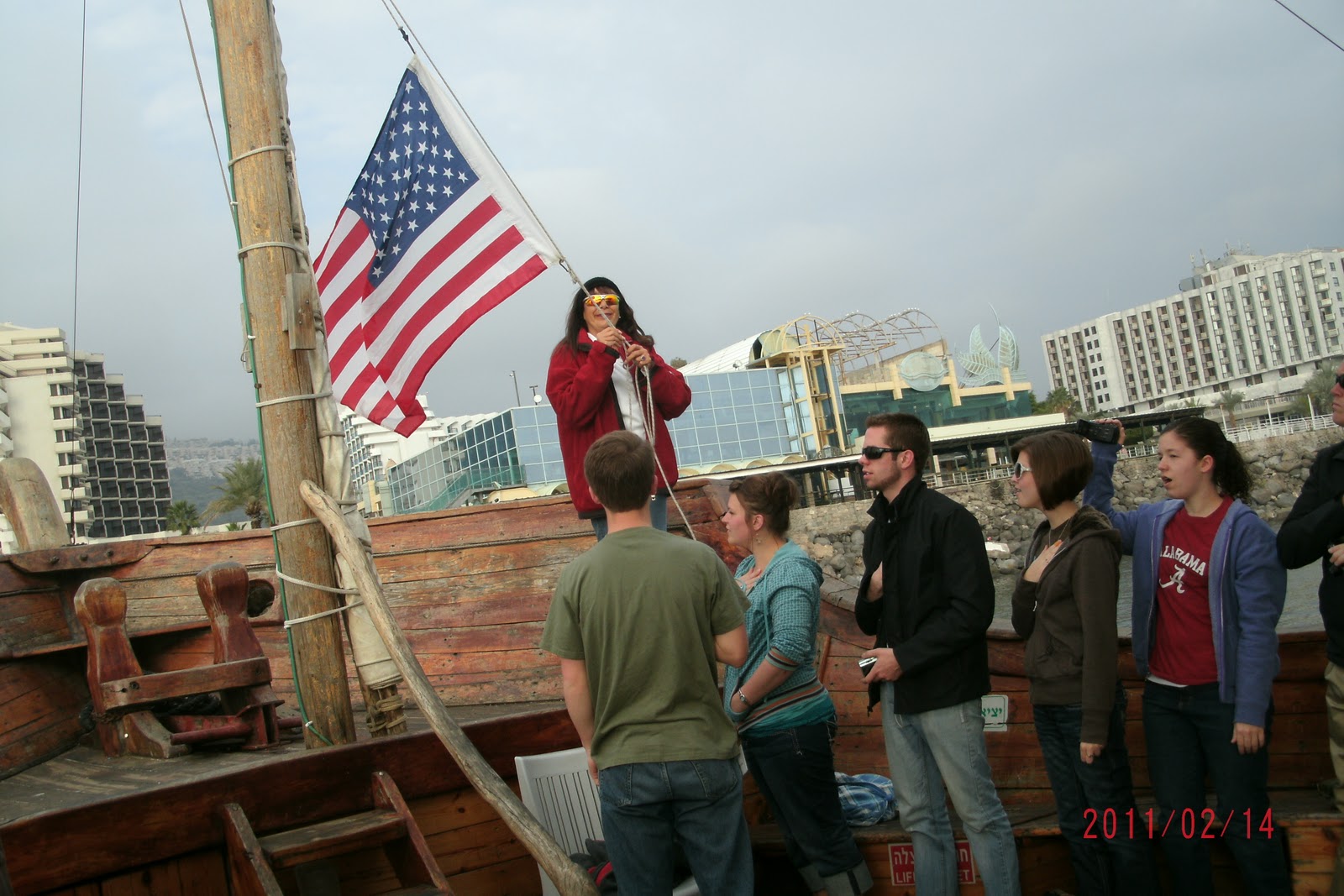
The Caesar Hotel is right beside the Sea of Galilee.  We had a beautiful morning to board our boat and sail out into the middle of the sea.  I tried to imagine what it would have been like to see Jesus walking across the water or seeing Him stand in the ship and order the winds and waves to cease.  We sang several songs and listened as Pastor Nason challenged us through the account of Peter walking on the water.  It was truly moving to think that we were in the place where our Lord had sailed and spent so much time.  We were able to see in the distance the home of Mary Magadalene where Jesus had cast out her demons and in the distance beyond that and to the north we could see the Golan Heights where Syria spent years shelling Israeli fisherman.  We could also see the Valley of Winds which has been the cause of many of the spontaneous and fierce storms that pop up.
After coming to shore on the far side of the water, we boarded our bus and headed to several spots.  Our first stop was the Mount of the Beatitudes.  As with many of the stops in the Holy Land, this is a traditional spot.  There we read the Beatitudes and prayed.  It was amazing to think that Jesus had been so near or even right there when preaching many of His sermons to the multitudes.  
Next we went to The supposed place where Jesus met the disciples after His death.  We were able to stop and read John 21 and then spent a little bit of time on the shore.  I can imagine as Jesus asked Peter about how much he loved Him that Peter could not only see the fish and fishing boats, but also all of the surrounding villages and ports.  “Lovest thou me more than these?”  What a powerful question  that implied more than just the conversation and fish that lay near them.  Peter’s love needed to be more than just friendship and it needed to supersede anything that had to do with fishing and materialism.  It needed to be the selfless agape love that he had the privilege of displaying by his martyring.
We continued to Capernaum, the home of Peter and, the home base of Jesus while He ministered in this region.  How awesome to stand in the synagogue that stood over the old synagogue in which Jesus actually stood and taught.  It was a moving and humbling experience.
We had lunch by the side of the sea at an open air restaurant where many of our group experienced the St. Peter’s Fish plate.  It was very good, but to our disappointment no one found a coin in the mouth of their fish.
After lunch, we boarded our bus and continued our trip by driving around the north side of the sea and then south toward Beth Shean.  We passed by the cities of Chorazin and Bethsaida.  Cities which Jesus cursed in Matthew 11 (Capernaum was the third).  None of them to this day exist but as ruins.  We read the Scripture from  Luke 10 as we passed by the ruins and were reminded that God keeps His word.
Arriving in Beth Shean, we had a stark change in heart and attitude as we drove by the outer edge of its uncovered ruins.  It was there that we passed the amphitheater where many Jews and Christians were slaughtered in the first century.  We went from the heights of Christian heritage to the darkest hour that many suffered.  What a reminder of the passage when Jesus taught us that the servant is not greater than his master.  Just as He suffered, so did many of His early followers.  Beth Shean was the capital of Decapolis, a league of ten Greco-Roman cities on the east side of the sea of Galilee.  It was a truly wicked city and is not a wonder that it is never mentioned that Jesus visited there.
We visited the theater and read the only Biblical account where the city was mentioned, the death of King Saul.  It was here that his body and the body of his sons were hung at the city gates.  After reading and meditating, we had a group sing on the stage while the group listened from the highest existing level.  They could be clearly heard!  What a feat of engineering.
As we walked through the ruins of the city, we talked about the majesty and beauty in which it existed.  It was a place that would be very attractive to someone coming from a small village like Bethsaida or Bethlehem.  Filled with splendor and architecture, places of worship to Tyche, Pan, and Dionysius, and every pleasure that the heart could want, Beth Shean was a place that could swallow up the heart and mind of a believer or faithful Jew  of that day and leave them with the emptiness that this world gives at the end of its pleasures.
It made the apostle John’s charge come alive, Love not the world, neither the things that are in the world. If any man love the world, the love of the Father is not in him.  For all that is in the world, the lust of the flesh, and the lust of the eyes, and the pride of life, is not of the Father, but is of the world.   And the world passeth away, and the lust thereof: but he that doeth the will of God abideth for ever.”  How easy it is for us to get caught up in the beauty and pleasure of this world.  Just as easy as it would have been in the days of the early Christians.

We left and headed back to our hotel and will get up and head toward Nazareth tomorrow, our first stop…